
Destination Sardinia
  • The island
    • History
    • Regions
    • Points of interest
    • Climate
    • Geography
    • Nature
    • Beaches
    • Festivals
    • Language
  • Travel time
  • Arrival
    • Car/Motorbike
    • Ferry
    • Plane
    • Train
  • Accommodation
    • Hotel
    • Bed and Breakfast
    • Holiday flat
    • Holiday house
    • Agriturismo
    • Camping
    • Campervan
  • Food and Drinks
    • Eating out
    • Self-catering
    • Culinary specialities
  • Mobility
    • Car
    • Motorbike
    • Bike
    • Bus
    • Railway
    • Ship and boat
  • Points of interest
  • Activities
    • Hiking
    • – Tour tips
    • Climbing
    • Surfing
    • Diving and snorkelling
    • Fishing
    • Riding
  • Pract. tips
    • Literature
    • Maps
    • Language
    • Post and telephone
    • Internet
    • Opening hours
    • Photography
    • Children
    • Health
    • Dogs and pets
    • Souvenirs
    • Weblinks
  • Menu Menu
  • The island
    • The island
    • History
    • Regions
      • Anglona/Turritano
      • Arborea
      • Barbagia
      • Baronia
      • Cagliari region
      • Campidano
      • Gallura
      • Iglesiente/Sulcis
      • Logudoro/Meilogu
      • Nurra
      • Ogliastra
      • Planargia
      • Quirra/Sarrabus
      • Sarcidano/Marmilla
    • Points of interest
      • Alghero
      • Alghero, north
      • Archipelago di La Maddalena
      • Ardara / Sant‘ Antioco di Bisarcio
      • Argentiera / Grotta di Nettuno
      • Aritzo
      • Arzachena and surroundings
      • Bosa
      • Burgos and surroundings
      • Cagliari
      • Capo Comino / Spiaggia di Berchida
      • Carbonia and Monte Sirai
      • Castelsardo and surroundings
      • Churches near Sassari
      • Costa del Sud
      • Costa Rei and hinterland
      • Costa Smeralda, Palau and surroundings
      • Costa Verde
      • Fonni and surroundings
      • Fordongianus
      • Giara di Gesturi
      • Gola su Gorroppu / Codula di Luna
      • Gulf of Orosei
      • Iglesias and Grotta di San Giovanni
      • Ingurtosu
      • Isola di Sant’Antioco
      • Is Pirois, Funtana Coberta, Pranu Muteddu
      • Ittireddu
      • Macomer and surroundings
      • Montiferru-Area
      • Nebida, Masua and Buggerru
      • Nora
      • Nuoro and surroundings
      • Nuraghe Arrubiu
      • Nuraghe Iloi and surroundings
      • Nuraghe Losa
      • Nuraghe Santu Antine / Sant‘ Andria Priu
      • Nuraghe Su Nuraxi
      • Olbia and surroundings
      • Orgosolo
      • Oristano / Sinis-Peninsula / Tharros
      • Orosei and Biderosa Nature Park
      • Orosei’s hinterland
      • Osini and Ulassai
      • Ozieri
      • Porto Torres and Monte d’Accoddi
      • Posada and Surroundings
      • Sadali
      • Santa Cristina
      • Santa Teresa / Capo Testa
      • Santa Vittoria
      • Sassari and Noeddale Necropolis
      • Sedini and Martis
      • Siniscola and Surroundings
      • Stintino and Isola Asinara
      • Su Golgo, Sa Pedra Longa, Santa Maria Navarrese
      • Su Romanzesu and Nuraghe Loelle
      • Su Tempiesu and Nuraghe Noddule
      • Tempio di Antas
      • Tempio Pausania and Surroundings
      • Tonara, Sorgono, San Mauro, Menhire Biru ‚e Concas
      • Trenino Verde (Arbatax-Sadali)
    • Climate
    • Geography
    • Nature
    • Beaches
    • Festivals
    • Language
  • Travel time
  • Arrival
    • Arrival
    • Car/Motorbike
    • Ferry
    • Plane
    • Train
  • Accommodation
    • Accommodation
    • Hotel
    • Campervan
    • Agriturismo
    • Bed and Breakfast
    • Camping
    • Holiday house
    • Holiday flat
  • Food and Drinks
    • Food and Drinks
    • Eating out
    • Self-catering
    • Culinary specialities
  • Mobility
    • Mobility
    • Car
    • Motorbike
    • Bike
    • Bus
    • Railway
    • Ship and boat
  • Points of interest
    • Alghero
    • Alghero, north
    • Archipelago di La Maddalena
    • Ardara / Sant‘ Antioco di Bisarcio
    • Argentiera / Grotta di Nettuno
    • Aritzo
    • Arzachena and surroundings
    • Bosa
    • Burgos and surroundings
    • Cagliari
    • Capo Comino / Spiaggia di Berchida
    • Carbonia and Monte Sirai
    • Castelsardo and surroundings
    • Churches near Sassari
    • Costa del Sud
    • Costa Rei and hinterland
    • Costa Smeralda, Palau and surroundings
    • Costa Verde
    • Fonni and surroundings
    • Fordongianus
    • Giara di Gesturi
    • Gola su Gorroppu / Codula di Luna
    • Gulf of Orosei
    • Iglesias and Grotta di San Giovanni
    • Ingurtosu
    • Isola di Sant’Antioco
    • Is Pirois, Funtana Coberta, Pranu Muteddu
    • Ittireddu
    • Macomer and surroundings
    • Montiferru-Area
    • Nebida, Masua and Buggerru
    • Nora
    • Nuoro and surroundings
    • Nuraghe Arrubiu
    • Nuraghe Iloi and surroundings
    • Nuraghe Losa
    • Nuraghe Santu Antine / Sant‘ Andria Priu
    • Nuraghe Su Nuraxi
    • Olbia and surroundings
    • Orgosolo
    • Oristano / Sinis-Peninsula / Tharros
    • Orosei and Biderosa Nature Park
    • Orosei’s hinterland
    • Osini and Ulassai
    • Ozieri
    • Porto Torres and Monte d’Accoddi
    • Posada and Surroundings
    • Sadali
    • Santa Cristina
    • Santa Teresa / Capo Testa
    • Santa Vittoria
    • Sassari and Noeddale Necropolis
    • Sedini and Martis
    • Siniscola and Surroundings
    • Stintino and Isola Asinara
    • Su Golgo, Sa Pedra Longa, Santa Maria Navarrese
    • Su Romanzesu and Nuraghe Loelle
    • Su Tempiesu and Nuraghe Noddule
    • Tempio di Antas
    • Tempio Pausania and Surroundings
    • Tonara, Sorgono, San Mauro, Menhire Biru ‚e Concas
    • Trenino Verde (Arbatax-Sadali)
  • Activities
    • Activities
    • Hiking
    • – Tour tips
    • Climbing
    • Surfing
    • Diving and snorkelling
    • Fishing
    • Riding
  • practical tips
    • practical tips
    • Literature
    • Maps
    • Language
    • Post and telephone
    • Internet
    • Opening hours
    • Photography
    • Children
    • Health
    • Dogs and pets
    • Souvenirs
    • Weblinks
  • Search…
You are here: Home1 / The island2 / Language

deutsch

Language

Italian is the official language

Italian is the official language

Italian is the official language spoken throughout Sardinia.
It is therefore a great advantage to know at least a few phrases. Your language skills and pronunciation do not have to be perfect.
The Sardinians will quickly reward your honest efforts with a friendly smile.

Very few tourists will have the opportunity to come into such close contact with the Sardinians that extensive language skills are necessary for a personal conversation.
In general, it is enough to learn the most important vocabulary with the help of a small phrase book – to ask for directions, to name goods when shopping or to place an order in a restaurant.
You should also have the phrase book with you to describe your symptoms in case you need to go to the doctor.
Numbers are very important! This starts when you arrive at the port, when you are directed to your ferry at a numbered pier and then have to follow the announcements on the ship.

In the tourist resorts by the sea, many locals also speak foreign languages.
French is the most common, because children learn it at school and it is related to Italian.
English doesn’t get you very far in Sardinia (as in all of Italy, by the way).
But you will be very surprised to see how many (especially older) Sardinians speak German. Forced by the economic situation on the island to look for work on the mainland, many also had moved to Germany. The money earned was then usually invested in building a house back home.

Police officers rarely have perfect foreign language skills. If you have problems and cannot communicate, insist on an interpreter.

Sardinian
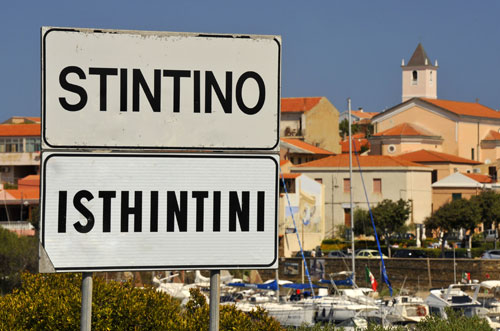
Stintino, Sardinian town sign

Stintino, Sardinian town sign

The roots of Sardinian lie in the Latin of the former Roman occupiers. In the course of Sardinia’s eventful history, the various colonial powers made their respective languages the official languages.
Thus, today we find many Spanish and Italian influences. Although Italian also developed from Latin, it was changed much more by external influences than Latin on the relatively isolated island.

The Sardinian language is by no means homogeneous, but breaks up into a multitude of dialects. Some of these are so different from each other that communication in Sardinian can be difficult even between neighbouring villages.
In addition, because of the different dialects, there is no homogeneous written Sardinian language.
As a result, Italian is the predominant colloquial language among the Sardinians today.

For several years, however, great efforts have been made to preserve the Sardinian language.
A great success was the recognition of Sardinian as an independent language by the Italian parliament in 1999. Since then it may be taught in schools on an equal footing with Italian.

Even if you communicate with the Sardinians in Italian, you will still come across foreign terms all over the island.
Above all, landscape names on maps are mainly named in Sardinian, such as:
genna = pass,
codula = gorge,
riu = river,
funtana = spring.
The spelling is often different.

If you want to learn more about the Sardinian language, I can recommend “GigaSardinian“.

Many villages and towns have an Italian and a Sardinian name. A few years ago, they started to label the town signs bilingually.

Search Search

Instagram

Follow us

Legal Notice

Legal Notice

Privacy Policy

Privacy Policy

Contact

Contact

© Copyright Traumziel-Sardinien 2009-2026
Scroll to top Scroll to top Scroll to top