
Destination Sardinia
  • The island
    • History
    • Regions
    • Points of interest
    • Climate
    • Geography
    • Nature
    • Beaches
    • Festivals
    • Language
  • Travel time
  • Arrival
    • Car/Motorbike
    • Ferry
    • Plane
    • Train
  • Accommodation
    • Hotel
    • Bed and Breakfast
    • Holiday flat
    • Holiday house
    • Agriturismo
    • Camping
    • Campervan
  • Food and Drinks
    • Eating out
    • Self-catering
    • Culinary specialities
  • Mobility
    • Car
    • Motorbike
    • Bike
    • Bus
    • Railway
    • Ship and boat
  • Points of interest
  • Activities
    • Hiking
    • – Tour tips
    • Climbing
    • Surfing
    • Diving and snorkelling
    • Fishing
    • Riding
  • Pract. tips
    • Literature
    • Maps
    • Language
    • Post and telephone
    • Internet
    • Opening hours
    • Photography
    • Children
    • Health
    • Dogs and pets
    • Souvenirs
    • Weblinks
  • Menu Menu
  • The island
    • The island
    • History
    • Regions
      • Anglona/Turritano
      • Arborea
      • Barbagia
      • Baronia
      • Cagliari region
      • Campidano
      • Gallura
      • Iglesiente/Sulcis
      • Logudoro/Meilogu
      • Nurra
      • Ogliastra
      • Planargia
      • Quirra/Sarrabus
      • Sarcidano/Marmilla
    • Points of interest
      • Alghero
      • Alghero, north
      • Archipelago di La Maddalena
      • Ardara / Sant‘ Antioco di Bisarcio
      • Argentiera / Grotta di Nettuno
      • Aritzo
      • Arzachena and surroundings
      • Bosa
      • Burgos and surroundings
      • Cagliari
      • Capo Comino / Spiaggia di Berchida
      • Carbonia and Monte Sirai
      • Castelsardo and surroundings
      • Churches near Sassari
      • Costa del Sud
      • Costa Rei and hinterland
      • Costa Smeralda, Palau and surroundings
      • Costa Verde
      • Fonni and surroundings
      • Fordongianus
      • Giara di Gesturi
      • Gola su Gorroppu / Codula di Luna
      • Gulf of Orosei
      • Iglesias and Grotta di San Giovanni
      • Ingurtosu
      • Isola di Sant’Antioco
      • Is Pirois, Funtana Coberta, Pranu Muteddu
      • Ittireddu
      • Macomer and surroundings
      • Montiferru-Area
      • Nebida, Masua and Buggerru
      • Nora
      • Nuoro and surroundings
      • Nuraghe Arrubiu
      • Nuraghe Iloi and surroundings
      • Nuraghe Losa
      • Nuraghe Santu Antine / Sant‘ Andria Priu
      • Nuraghe Su Nuraxi
      • Olbia and surroundings
      • Orgosolo
      • Oristano / Sinis-Peninsula / Tharros
      • Orosei and Biderosa Nature Park
      • Orosei’s hinterland
      • Osini and Ulassai
      • Ozieri
      • Porto Torres and Monte d’Accoddi
      • Posada and Surroundings
      • Sadali
      • Santa Cristina
      • Santa Teresa / Capo Testa
      • Santa Vittoria
      • Sassari and Noeddale Necropolis
      • Sedini and Martis
      • Siniscola and Surroundings
      • Stintino and Isola Asinara
      • Su Golgo, Sa Pedra Longa, Santa Maria Navarrese
      • Su Romanzesu and Nuraghe Loelle
      • Su Tempiesu and Nuraghe Noddule
      • Tempio di Antas
      • Tempio Pausania and Surroundings
      • Tonara, Sorgono, San Mauro, Menhire Biru ‚e Concas
      • Trenino Verde (Arbatax-Sadali)
    • Climate
    • Geography
    • Nature
    • Beaches
    • Festivals
    • Language
  • Travel time
  • Arrival
    • Arrival
    • Car/Motorbike
    • Ferry
    • Plane
    • Train
  • Accommodation
    • Accommodation
    • Hotel
    • Campervan
    • Agriturismo
    • Bed and Breakfast
    • Camping
    • Holiday house
    • Holiday flat
  • Food and Drinks
    • Food and Drinks
    • Eating out
    • Self-catering
    • Culinary specialities
  • Mobility
    • Mobility
    • Car
    • Motorbike
    • Bike
    • Bus
    • Railway
    • Ship and boat
  • Points of interest
    • Alghero
    • Alghero, north
    • Archipelago di La Maddalena
    • Ardara / Sant‘ Antioco di Bisarcio
    • Argentiera / Grotta di Nettuno
    • Aritzo
    • Arzachena and surroundings
    • Bosa
    • Burgos and surroundings
    • Cagliari
    • Capo Comino / Spiaggia di Berchida
    • Carbonia and Monte Sirai
    • Castelsardo and surroundings
    • Churches near Sassari
    • Costa del Sud
    • Costa Rei and hinterland
    • Costa Smeralda, Palau and surroundings
    • Costa Verde
    • Fonni and surroundings
    • Fordongianus
    • Giara di Gesturi
    • Gola su Gorroppu / Codula di Luna
    • Gulf of Orosei
    • Iglesias and Grotta di San Giovanni
    • Ingurtosu
    • Isola di Sant’Antioco
    • Is Pirois, Funtana Coberta, Pranu Muteddu
    • Ittireddu
    • Macomer and surroundings
    • Montiferru-Area
    • Nebida, Masua and Buggerru
    • Nora
    • Nuoro and surroundings
    • Nuraghe Arrubiu
    • Nuraghe Iloi and surroundings
    • Nuraghe Losa
    • Nuraghe Santu Antine / Sant‘ Andria Priu
    • Nuraghe Su Nuraxi
    • Olbia and surroundings
    • Orgosolo
    • Oristano / Sinis-Peninsula / Tharros
    • Orosei and Biderosa Nature Park
    • Orosei’s hinterland
    • Osini and Ulassai
    • Ozieri
    • Porto Torres and Monte d’Accoddi
    • Posada and Surroundings
    • Sadali
    • Santa Cristina
    • Santa Teresa / Capo Testa
    • Santa Vittoria
    • Sassari and Noeddale Necropolis
    • Sedini and Martis
    • Siniscola and Surroundings
    • Stintino and Isola Asinara
    • Su Golgo, Sa Pedra Longa, Santa Maria Navarrese
    • Su Romanzesu and Nuraghe Loelle
    • Su Tempiesu and Nuraghe Noddule
    • Tempio di Antas
    • Tempio Pausania and Surroundings
    • Tonara, Sorgono, San Mauro, Menhire Biru ‚e Concas
    • Trenino Verde (Arbatax-Sadali)
  • Activities
    • Activities
    • Hiking
    • – Tour tips
    • Climbing
    • Surfing
    • Diving and snorkelling
    • Fishing
    • Riding
  • practical tips
    • practical tips
    • Literature
    • Maps
    • Language
    • Post and telephone
    • Internet
    • Opening hours
    • Photography
    • Children
    • Health
    • Dogs and pets
    • Souvenirs
    • Weblinks
  • Search…
You are here: Home1 / The island2 / Nature

deutsch

The nature of Sardinia

Flora
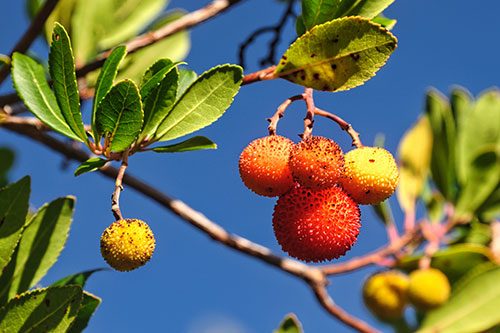
strawberry tree.

The fruits of the strawberry tree.

The plant life on Sardinia belongs to the evergreen Mediterranean vegetation.
Until the middle of the 19th century, there were extensive mixed forests, which, apart from a few isolated remnants, fell victim to ruthless overexploitation.
During industrialisation, there was a high demand for wood for railway sleepers, for smelting the mined ores and for the production of charcoal.

The former undergrowth of the Sardinian forests now forms the so-called “macchia” – bushes and dwarf shrubs that cover almost the entire island. In spring, these shrubs form a colourful sea of flowers and in summer they exude the scents of their essential oils. Often the prickly bushes are so dense that hiking off the paths is impossible.
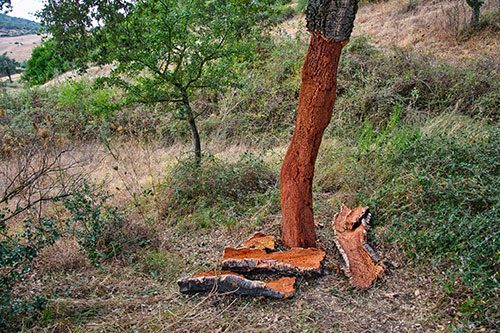
freshly peeled cork oak

In the few forests, holm oaks, strawberry trees and olive trees have survived. In some places there are also chestnut trees and – especially in the north – cork oak forests.
The cork oak is of great economic importance – about 80% of the entire Italian cork production comes from Sardinia. In addition to cork production, these forests also serve as important pasture land.

In order to accelerate the draining of the marshes, many eucalyptus trees were planted in the 20th century, because they extract a lot of moisture from the soil.
In the hinterland of the long sandy beaches, extensive pine forests were planted to consolidate the sandy soil. This created beautiful shady oases, which are used for campsites in many places.

In the meantime, there are many reforestation projects. However, these projects take a long time, because the native species, such as the holm oak, grow very slowly and the browsing by sheep and goats destroys many of them.
The most beautiful and interesting forests in terms of their species’ richness are the “foreste demaniali” (designated state forests).
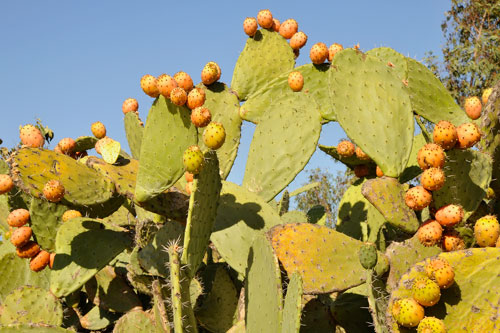
Prickly pear cacti

Prickly pear cacti with fruits

The prickly pear cactus can be found almost everywhere and is also popular as a hedge boundary around the perimeter of a property.
The species originates from America. Its name “Fico d’India” (Indian fig) is reminiscent of the time of the discovery of America, when people still thought they were in India.

Caution is advised when picking and peeling the tasty fruits, as they are covered with countless tiny spines that penetrate the skin and are barely visible.

The date palm, often found in the villages, was imported by the Arabs.
In recent years, however, many of these palms have unfortunately become threatened by the introduced red palm weevil. This species of beetle, originally found in Asia, has now spread throughout the Mediterranean.
The famous river promenade in Bosa also fell victim to this beetle and the palms had to be felled.

The dwarf palm is native – its leaves are used to make pretty basketry, which you can buy in souvenir shops everywhere.

The wild growing myrtle offers white flowers in spring and blue or reddish, fragrant berries in late summer. The fruits are used to make the famous liqueur “mirto sardo”.

Fauna
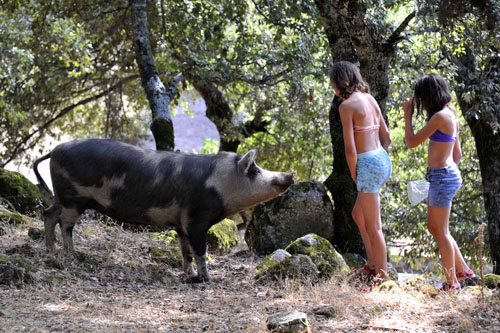
wild pig

In the mountains you often meet semi-wild domestic pigs

Sardinia’s wildlife has suffered badly from the Sardinians’ passion for hunting and is anything but species-rich.

Hunting the few mouflons and Sardinian deer is strictly forbidden today, but the populations are recovering very slowly.
In the mountains there are still hares, wild boars, wild cats, foxes and, above all, semi-wild domestic pigs, which are encountered quite frequently on hikes.
Most of these pigs are quite shy. In some areas, however, they have become accustomed to tourists and even beg them.

Colourful iridescent lizards and butterflies are everywhere. Occasionally, one also encounters snakes, all of which are harmless and non-poisonous.
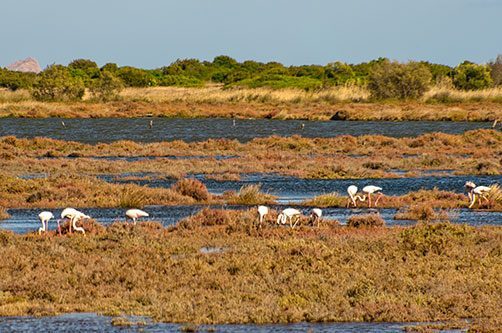
flamingos

Flamingos in the Stagno di San Teodoro

The birdlife has also been decimated by hunting. Pheasants, partridges and songbirds are still considered as a delicacy.
The island’s famous eagles and vultures have become extremely rare.
The draining of the marshes in the coastal plains may have defeated malaria, but it has also destroyed the habitat of many bird species native to the area.
In the meantime, some of the lagoons have been declared a nature reserve. Most striking are the huge pink flocks of flamingos. About 8,000 flamingos spend the winter here, some even stay the whole year.

The underwater population has been severely reduced by fishing.
In the sea, numerous spiny lobsters still live in some places, and mullets and eels spawn in the “stagni” (lagoon lakes).
Tuna still pass by Sardinia every year. Especially at Isola di San Pietro, tuna fishing has a long tradition. Most of the catch is exported to Japan.

The Monte Arcosu nature reserve, founded by the WWF, is one of the last retreats for the original Sardinian fauna. Created mainly to protect the Sardinian deer, it is now home to a variety of animals and plants that have already become very rare in Sardinia.

Wild fires
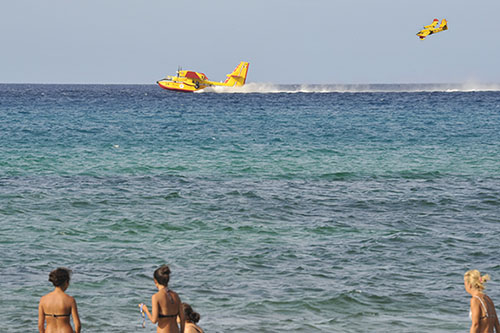
Firefighting aircraft

Firefighting aircraft taking on water at the beach

A big problem for the Sardinian flora and fauna are the wild fires that flare up every year.
Particularly in the dry summer months, fires occur again and again, often caused by carelessness such as discarded cigarette butts. Unfortunately, there is also often deliberate arson.
The initially small fires are further fanned by the strong winds and spread rapidly. In the summer of 2012, the fires were particularly bad due to the prolonged drought and heat.

These fires are fought mainly from the air with fire-fighting planes and helicopters. The water needed is either taken from the reservoirs in the interior of the country or salt water from the sea is used.

The scars on the landscape are visible for years to come.
You can help to prevent these fires by not lighting open fires, carefully stubbing out your cigarettes and immediately reporting any emerging fire by calling 115.

Search Search

Instagram

Follow us

Legal Notice

Legal Notice

Privacy Policy

Privacy Policy

Contact

Contact

© Copyright Traumziel-Sardinien 2009-2026
Scroll to top Scroll to top Scroll to top